R. Sammy
The Caves of SteelR. Sammy is Commissioner Julius Enderby’s errand boy, a robot whose reassignment displaces a human worker and whose destruction becomes part of the chain of evidence surrounding Dr. Roj Nemennuh Sarton’s murder. He occupies a small position in the police department, but his movements connect Enderby’s effort to incriminate Elijah Baley with Baley’s reconstruction of how the murder was carried out. The case turns on the difference between what R. Sammy’s remains can establish and what they cannot: they reveal the robot’s destruction and support Baley’s account of the weapon’s transfer, but do not prove that Enderby committed murder.
Identity and Position
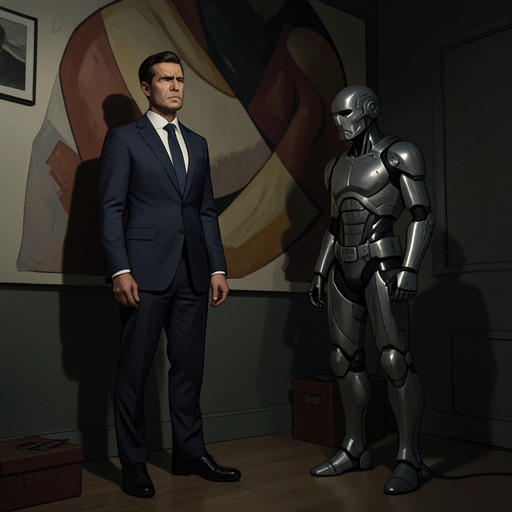
R. Sammy serves as Enderby’s private subordinate. Baley recognizes him as the Commissioner’s personal flunky, a detail that marks the robot’s closeness to departmental authority and prompts Baley to reflect on the privileges attached to being Commissioner. R. Sammy appears not as an independent investigator or decision-maker, but as an errand boy who carries out the Commissioner’s instructions.
That role has a human consequence. Vincent Barrett has been moved out of his job to make room for R. Sammy. When Barrett approaches Baley, he is standing in an unnoticed corner, turning a skull cap in his hands and attempting a smile. The episode gives the robot’s place in the department a second meaning: his employment is bound up with the displacement of a young human worker. The evidence establishes the change in jobs, while leaving R. Sammy’s own understanding of that arrangement unstated.
Destruction and Discovery
R. Sammy’s remains are discovered in a photographic supply room at the department. Dr. Anthony Gerrigel recounts that, after taking a wrong turn while using a guide rod, he found the robot lying there and determined that its brain had been irreversibly deactivated. The discovery is initially relayed to Baley as the discovery of a corpse; when told that the dead figure is the errand boy, Baley reacts with disbelief, insisting that he had understood the report to concern a human body. R. Daneel Olivaw clarifies that the “corpse” is a robot with a completely deactivated brain.
Gerrigel’s examination supplies a specific physical clue. R. Sammy’s partly clenched right fist holds a shiny, ovoid alphasprayer about two inches long and half an inch wide, with a mica window at one end. The fist is in contact with the robot’s skull, as though touching his head had been R. Sammy’s final act. Gerrigel identifies the device as the cause of the deactivation. The object’s position links the robot’s destruction to the weapon, making the discovery more than confirmation that R. Sammy is dead: it gives the investigators material evidence to interpret.
Baley’s Reconstruction
During his confrontation with Enderby, Baley argues that the Commissioner had been at the Williamsburg power plant, obtained the alphasprayer, and given it to R. Sammy. Baley says Enderby selected the location to incriminate him, then exploited Gerrigel’s return by inviting the doctor to the department and giving him a deliberately maladjusted guide rod. In Baley’s account, the rod led Gerrigel to the photographic supply room, where the doctor would find R. Sammy’s remains and correctly identify the cause of deactivation.
Baley extends the accusation into a reconstruction of Sarton’s murder. He proposes that Enderby put a blaster into R. Sammy’s hand, instructed the robot where and when to go, and then entered Spacetown through the Personal, where his own blaster was taken from him. According to Baley, Enderby received the other weapon from R. Sammy, killed Dr. Sarton, returned the blaster to the robot, and sent R. Sammy back across the fields to New York City. Baley argues that Enderby later destroyed the robot because its knowledge had become dangerous. The theory also accounts, in Baley’s view, for the Commissioner’s presence and the absence of a weapon, without requiring a human New Yorker to cross a mile of open country at night.
These details belong to Baley’s accusation, not to an independently confirmed account of R. Sammy’s actions. The remains and the alphasprayer are discovered facts; the proposed journey, transfer of the blaster, and Enderby’s purpose are Baley’s explanation of them. R. Daneel Olivaw rejects the conclusion that Enderby committed deliberate murder, citing the Commissioner’s cerebroanalytic profile as incompatible with such an act. The exchange leaves R. Sammy’s role central to the investigation while distinguishing circumstantial evidence from a proven motive and course of action.
Relationships and Narrative Significance
R. Sammy’s most consequential relationship is with Enderby, who is both his superior and, in Baley’s reconstruction, the person directing his movements and ultimately destroying him. The robot’s subordinate position makes him a possible instrument in the Commissioner’s plan, while his alleged knowledge makes him a liability. The story does not provide R. Sammy’s own account or establish what he understood; his significance is pieced together through Baley’s suspicions, Gerrigel’s examination, and the physical evidence found with his body.
His displacement of Barrett also places the robot within the broader conflict over human work and robot employment. The episode does not turn R. Sammy into the cause of Barrett’s loss by personal choice: it identifies the job transfer as an institutional decision that benefits the Commissioner’s robot while removing the young man from his position. R. Sammy’s brief appearance therefore connects the department’s hierarchy to a wider question of who pays for the adoption of robots.
Finally, the manner of his discovery gives the investigation a pointed reversal. R. Sammy is at first introduced as an official’s convenient errand boy; later, that apparently minor function becomes part of a murder theory, and the robot’s deactivated body becomes evidence against the authority he served. Yet evidence is not resolution. Baley’s reconstruction explains why R. Sammy might have carried the weapon and why someone might have silenced him, while Daneel’s refusal to accept the accusation prevents the robot’s remains from serving as simple proof of Enderby’s guilt. R. Sammy matters because the case’s most consequential account of him remains an inference assembled from his position, his destruction, and the object left in his hand.